Over the years, while working with customers, banks, builders, small business owners, shopkeepers, self-employed individuals, and family-run businesses, I have observed something interesting.
Most people work very hard.
Very few people stop to think.
They wake up, follow routines, follow industry practices, follow what others are doing, follow what society expects, and then wonder why their business is not growing differently from everyone else’s.
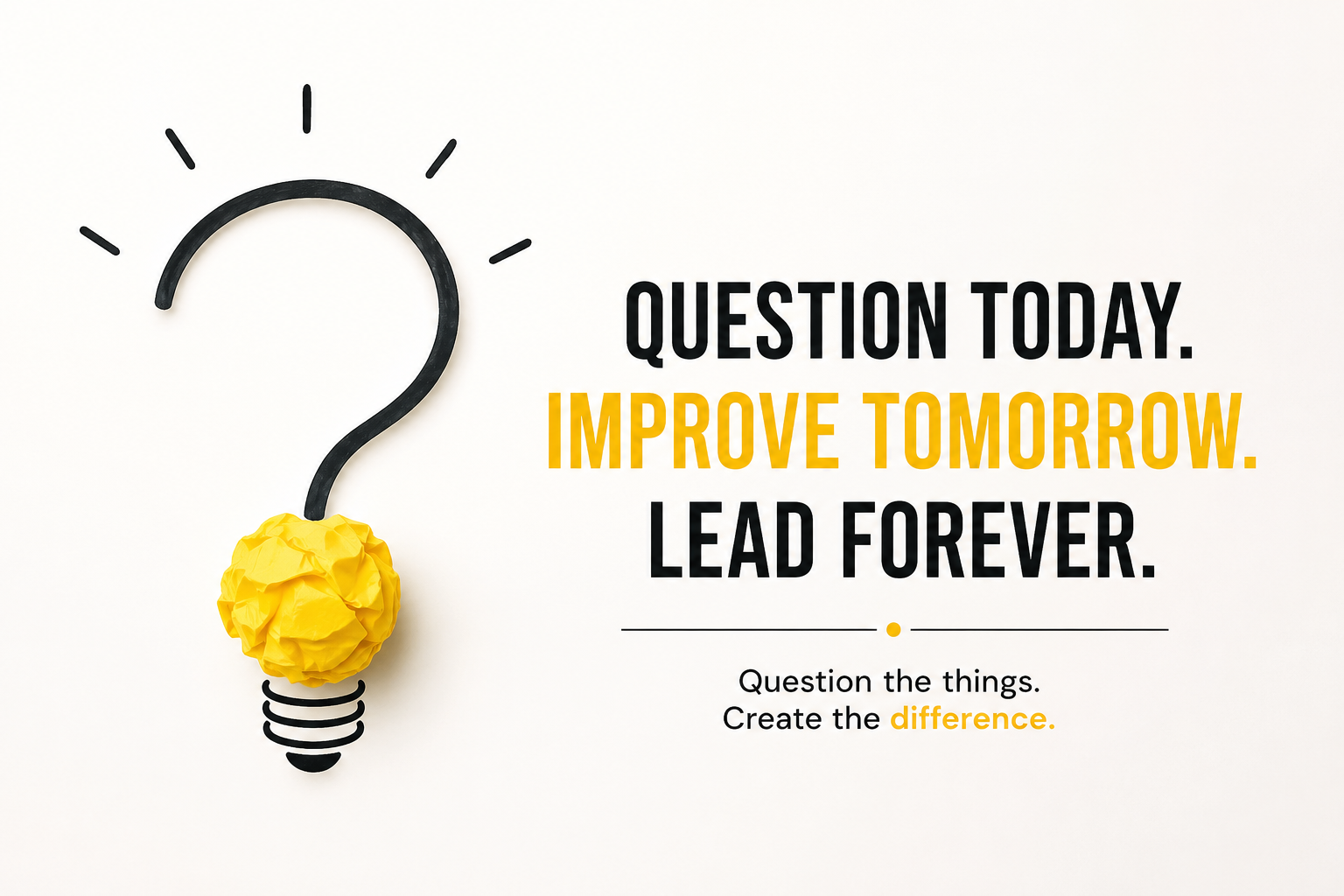
I believe one of the most important habits for an entrepreneur is to question things.
Not to criticize everything.
Not to rebel against everything.
But to understand why things are being done in a particular way.
Many of us inherit business practices just like we inherit traditions. We rarely ask whether they still make sense.
Why are we serving customers in this way?
Why is our pricing structured like this?
Why is our industry operating like this?
Why do customers still feel dissatisfied?
Why are they still confused?
Why are they still moving from one service provider to another?
The answers to these questions often contain the next business opportunity.
The Problem with Small Businesses Today
Many small businesses in India are facing intense competition.
Take a salon.
A person learns the skill, gains experience, and eventually opens another salon.
Take a snack shop.
A successful item starts selling, and soon several nearby shops offer the same thing.
Take a kirana store.
Products are largely similar, suppliers are often similar, and pricing differences are limited.
The reality is that skills can be copied.
Products can be copied.
Processes can be copied.
Prices can be copied.
Even technology can be copied.
If your entire business depends only on these things, competition will eventually catch up.
So what cannot be copied easily?
The relationship with the customer.
Customers Don’t Always Need More Products
Many business owners spend their time looking for new customers.
I think they should spend more time understanding their existing customers.
Every customer who walks into your business is carrying information.
They are carrying problems.
They are carrying frustrations.
They are carrying unmet needs.
They are carrying future opportunities.
The entrepreneur who listens carefully will discover new business ideas without spending money on consultants or market research.
Ask yourself:
What are my customers repeatedly asking for?
What difficulties do they face after buying from me?
What additional help can I provide?
What other services are connected to my existing business?
How can I solve a bigger portion of their problem?
Many businesses discover their next line of growth simply by serving existing customers better.
Spend Two Hours a Week Thinking
Most small business owners are not lacking effort.
They are lacking thinking time.
I strongly believe every entrepreneur should reserve at least two or three hours every week for thinking.
No phone.
No meetings.
No sales calls.
No daily operational work.
Just thinking.
Observe your industry.
Observe your customers.
Observe your competitors.
Then ask difficult questions.
What is changing?
What is becoming easier?
What is becoming obsolete?
What are customers tolerating that they shouldn’t have to tolerate?
What small improvement can I introduce in my geographical area?
You do not need to transform your business overnight.
One useful improvement every few months can completely change the direction of a business over a few years.
We Live in a Different Era Now
Earlier, a small business owner had to do everything alone.
Research was expensive.
Technology was expensive.
Expert advice was expensive.
Today, things are different.
A single entrepreneur can access tools that were unavailable even to large companies a few years ago.
You have AI.
You have ChatGPT.
You have Gemini.
You have powerful language models that can help you brainstorm, learn, analyze, communicate, create content, design processes, understand customers, and explore opportunities.
For many small business owners, AI can become a researcher, assistant, trainer, strategist, and thought partner.
But there is one caution.
Do not rush.
Technology can move much faster than human understanding.
If you try to consume everything at once, you may collect hundreds of ideas and implement none.
Go slowly.
Learn patiently.
Think deeply.
Ask better questions.
Use AI not as a replacement for your thinking, but as a tool to strengthen your thinking.
The Human Advantage
As technology becomes common, human qualities become more valuable.
Empathy.
Humility.
Compassion.
Creativity.
Integrity.
Trust.
The ability to genuinely care about another person’s outcome.
These are not old-fashioned values.
These are competitive advantages.
A customer may forget your pricing.
A customer may forget your product details.
But they rarely forget how you treated them.
The businesses that survive for decades are often not the businesses with the best products.
They are the businesses that create the strongest relationships.
My Simple Belief
I believe the future belongs to business owners who combine three things:
The curiosity to question.
The patience to learn.
The humanity to build relationships.
Most opportunities are hidden behind questions that nobody is asking.
Most innovations are hidden inside customer frustrations that everyone has accepted as normal.
And most growth begins when an entrepreneur sits quietly for a few hours and asks:
“Why are things still being done this way?”
That single question has built companies, created industries, and changed lives.
Perhaps it can change your business too.