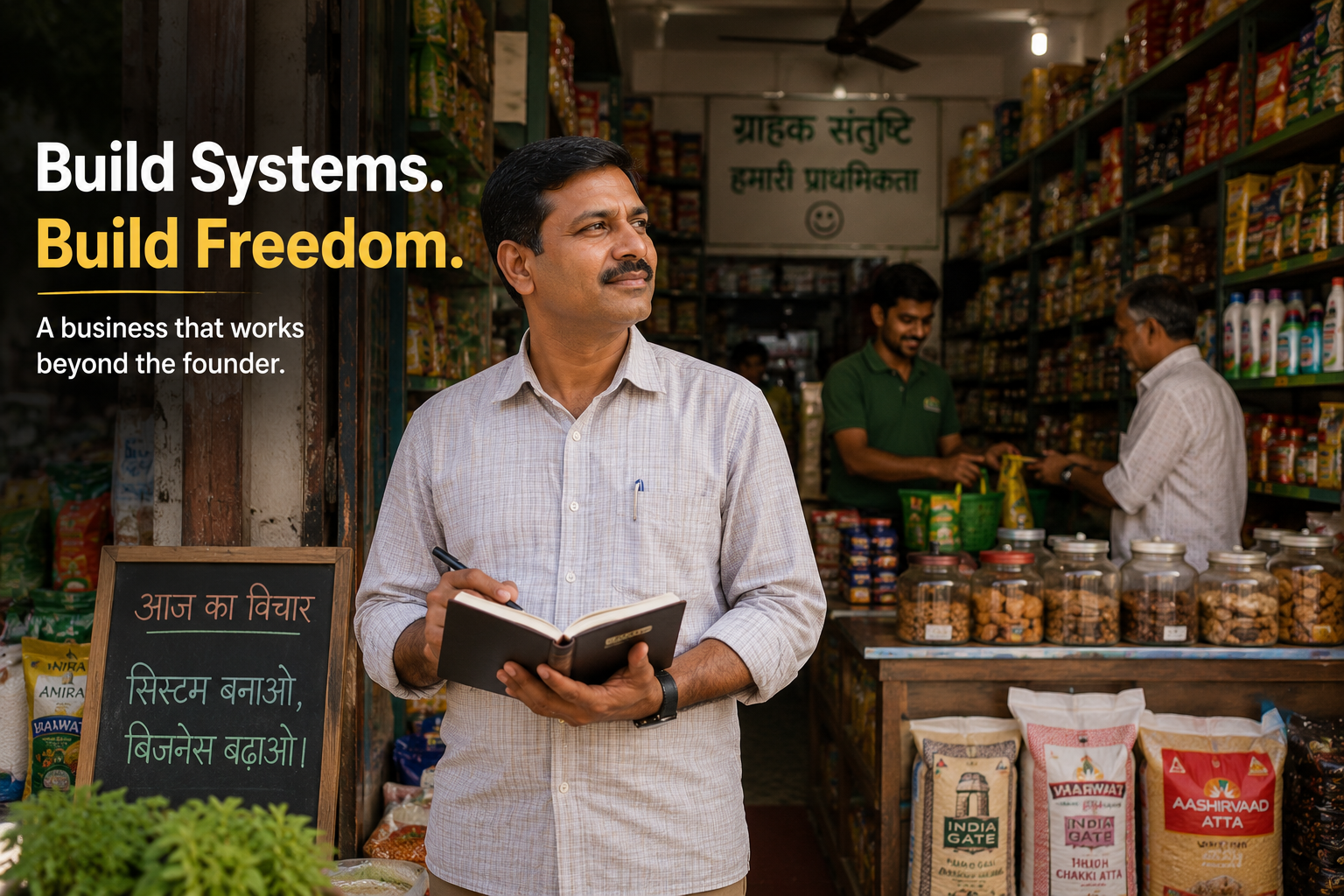
When I left my job in financial services and started my own business, I thought I had figured it out.
I was good at sales.
I understood customers.
I understood lending.
I knew how deals moved from inquiry to approval.
Like many people who start a business, I believed something very simple:
“If I know how to do the work, I know how to run the business.”
Looking back, I realize that this is one of the biggest mistakes small business owners make.
And it is a mistake that continues to be repeated across India every day.
The Story of Most Indian Businesses
A skilled barber opens a salon.
A mechanic opens a garage.
A chef opens a restaurant.
A salesperson starts a distribution business.
A loan consultant starts a financial services firm.
A designer starts a design agency.
A software engineer launches a startup.
The story is almost always the same.
Someone becomes very good at a skill.
Then they decide to start a business around that skill.
At first, everything makes sense.
After all, if you know the work better than most people, why shouldn’t you succeed?
The problem is that running a business and performing the work are two completely different things.
Knowing how to cut hair does not teach you customer acquisition.
Knowing how to process loans does not teach you business systems.
Knowing how to cook does not teach you team management.
Knowing how to write software does not teach you how to build an organization.
Many of us learn this lesson only after starting.
The Excitement of Entrepreneurship
The early days are exciting.
You feel independent.
You make your own decisions.
You create your own identity.
You believe that your future is finally in your own hands.
I experienced the same feeling.
The initial years were difficult, but gradually things started working.
The business grew.
Customers came.
Relationships strengthened.
The numbers improved.
The business reached levels that I had once dreamed about.
From the outside, it looked like success.
And it was.
But success revealed a problem I had not noticed before.
The Question That Changed My Thinking
During one of the strongest phases of my business journey, I asked myself a simple question.
“What happens if I am not here tomorrow?”
The answer made me uncomfortable.
The customers depended on me.
The banks depended on me.
The knowledge was in my head.
The relationships were dependent on me.
The decisions were dependent on me.
The business was growing.
But the business was also becoming dependent on me.
That was the moment I realized something important.
I had built a successful business.
But I had also become the bottleneck.
If I was removed from the system, the system would struggle.
And that is a dangerous position for any entrepreneur.
Growth Without Systems Is Fragile
Many business owners focus only on growth.
More customers.
More revenue.
More employees.
More branches.
More products.
Growth feels good.
But growth without systems is fragile.
As long as the founder is present, everything works.
But when the founder becomes unavailable, the cracks begin to appear.
This is why many businesses that look successful from outside are actually vulnerable inside.
The climb can be fast.
The fall can be even faster.
I have seen this happen around me.
And I have experienced parts of it myself.
That is why I would like to share one lesson with young entrepreneurs:
Do not wait until you become successful to build systems. Build them while you are growing.
The Mistake Previous Generations Made
I believe many traditional businesses in India suffered from the same challenge.
The founder became the system.
The knowledge remained in people’s heads.
Processes were never documented.
Training happened informally.
Customers trusted individuals rather than organizations.
The business worked.
Sometimes for decades.
But scaling became difficult.
Succession became difficult.
Expansion became difficult.
The business remained dependent on a handful of people.
The previous generation worked incredibly hard.
In many cases, much harder than we do today.
But they did not always have access to the tools required to build scalable systems.
That is where I believe our generation has an advantage.
Why I Am Optimistic About the Future
For the first time in history, a small business owner has access to capabilities that were previously available only to large organizations.
Artificial Intelligence is changing the equation.
And I believe we are only at the beginning of this transformation.
A single-person business can now have access to something that resembles an entire support team.
AI can act as a strategist.
AI can act as a researcher.
AI can act as a trainer.
AI can help create content.
AI can help organize knowledge.
AI can help design processes.
AI can assist with customer communication.
AI can support analysis and decision-making.
No, it does not replace human judgment.
No, it does not replace relationships.
No, it does not replace trust.
But it dramatically increases what one individual can achieve.
For the first time, a small entrepreneur can think bigger without immediately needing a large team.
The Most Innovative Era for Indian Businesses
This is why I am optimistic.
India has millions of small businesses.
Shop owners.
Consultants.
Agents.
Service providers.
Family businesses.
Professionals.
Independent entrepreneurs.
For decades, many of them were limited by access to expertise and systems.
Today, that limitation is starting to disappear.
A business owner sitting in a small town can now access world-class knowledge within minutes.
A founder can brainstorm with AI.
Learn with AI.
Build systems with AI.
Document processes with AI.
Think through strategy with AI.
What once required departments can increasingly be supported by intelligent tools.
I genuinely believe we are entering one of the most innovative periods in the history of Indian entrepreneurship.
The Real Opportunity
The opportunity is not simply to work harder.
Indian entrepreneurs have always worked hard.
The opportunity is to build better.
To build businesses that do not depend entirely on memory.
To build businesses that do not depend entirely on the founder.
To build organizations where knowledge is captured, processes are documented, and systems become assets.
That is exactly what we are trying to do today.
In some ways, our growth slowed because we chose to focus on systems.
From the outside, that may not always look impressive.
But I believe it is the right investment.
Because a business that depends entirely on one person is vulnerable.
A business supported by systems becomes resilient.
And now, with AI, building those systems is becoming easier than ever before.
A Message to Gen Z Entrepreneurs
If you are starting a business today, you are entering entrepreneurship at a remarkable moment in history.
Learn your skill.
Master your craft.
Serve your customers.
But do not stop there.
Document your knowledge.
Build processes.
Create systems.
Use AI thoughtfully.
Think beyond your own daily effort.
Because being good at the work may help you start a business.
But building systems is what allows that business to survive, scale, and outlive you.
And that, in my opinion, is the difference between owning a job and building an institution.